
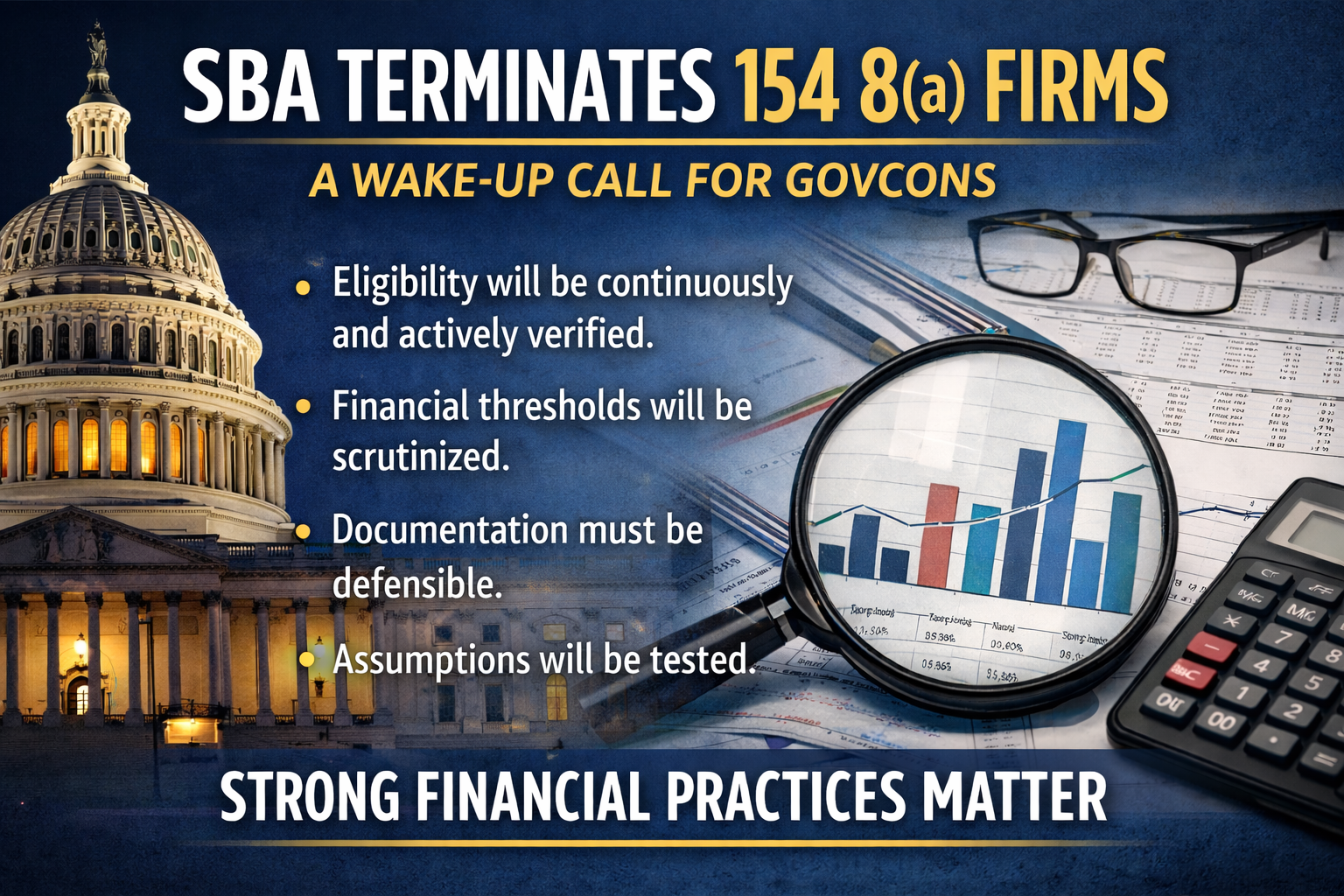
SBA Moves to Terminate 154 8(a) Firms: Why Strong Financial Discipline Is No Longer Optional
On February 11, 2026, the U.S. Small Business Administration (SBA) announced it had initiated termination proceedings against 154 Washington, D.C.-based 8(a) firms following an eligibility review. According to the SBA, these firms failed to meet the program’s “economic disadvantage” requirements and collectively received nearly $1.3 billion in federal contracts between FY 2021 and 2024.
The firms were cited for exceeding statutory thresholds related to:
- Net worth limits
- Adjusted gross income caps
- Total asset limits
The announcement also noted that some firms significantly exceeded those limits while continuing to pursue 8(a) set-aside and sole-source awards.
Regardless of political perspective, one thing is clear:
“The compliance environment for government contractors is tightening and financial documentation is under a microscope.”
Program Integrity and Financial Transparency
The SBA’s Office of Government Contracting and Business Development conducted an internal review as part of broader program integrity and transparency efforts. In 2025, the SBA initiated the first-ever audit of the 8(a) program in its nearly 50-year history. Thousands of firms were required to submit three years of financial documentation, and over 1,000 firms were suspended for non-compliance.
This signals a fundamental shift:
- Eligibility will be continuously and actively verified.
- Financial thresholds will be scrutinized.
- Documentation must be defensible.
- Assumptions will be tested.
For 8(a) participants and all small businesses pursuing federal contracts, this is a wake-up call.
Compliance Is Not a Check-the-Box Exercise
Too many companies treat compliance as a periodic administrative task:
- Submit the annual review.
- Update the SBA portal.
- Provide financial statements.
- Move on.
But eligibility requirements tied to economic disadvantage, ownership, and control are rooted in financial reporting accuracy. That means:
- Personal net worth calculations must be accurate and well-supported.
- Asset valuations must be defensible.
- Income reporting must be reconciled to tax returns and financial statements.
- Corporate financials must be timely and GAAP-consistent.
- Distributions, loans, and equity changes must be properly documented.
When accounting practices are loose, inconsistent, or reactive, eligibility risk increases, even if the business is operating in good faith.
The Hidden Risk: Growth Without Governance
Many contractors grow rapidly once they gain access to 8(a) set-aside and sole-source awards. Revenue increases. Assets grow. Owners accumulate wealth.
Without proactive financial modeling and compliance monitoring, companies can unknowingly cross eligibility thresholds.
The risk is not just removal from the program but:
- Suspension from contracting opportunities
- Reputational damage
- Increased scrutiny from contracting officers
- Cash flow disruption
- Potential clawbacks or legal exposure
Growth without disciplined financial oversight can create compliance exposure and have real consequences that can dramatically change the course of a business.
Why a Trusted Partner Matters
This is where experienced GovCon financial leadership like BlueStreet becomes critical.
A BlueStreet does more than produce financial statements. We:
- Monitor eligibility thresholds year-round
- Perform proactive net worth and asset modeling
- Ensure documentation withstands audit scrutiny
- Establish internal controls around distributions and related-party transactions
- Maintain DCAA-ready accounting systems
- Provide board-level financial transparency
In today’s environment, reactive bookkeeping is not enough. You need structured, disciplined, forward-looking financial governance.
Strong Accounting Practices Protect More Than Eligibility
Even outside the 8(a) program, the same principles apply across:
- Small Business Set-Asides
- HUBZone
- SDVOSB
- WOSB
- Mentor-Protégé relationships
- Cost-reimbursable contracts
- Incurred cost submissions
The SBA’s recent actions underscore a broader reality:
Federal contracting programs are shifting from trust-based participation to audit-based enforcement.
Companies that invest in strong financial infrastructure will not only maintain compliance, but they will operate with greater confidence, credibility, and scalability.
Final Thoughts
The termination of 154 firms is not just a headline but a signal to the market. Compliance is no longer passive. Eligibility is no longer assumed. Financial discipline is no longer optional.
For government contractors, the question is not whether scrutiny is increasing, it’s whether your accounting systems, documentation, and financial oversight are strong enough to withstand it.
Working with a trusted, experienced GovCon financial partner ensures that growth, profitability, and compliance move together and not in conflict.